

Towing a caravan in South Africa requires more than just a tow bar and a sense of adventure. Since the transition to the credit card-style licenses in 1998, the legal requirements for towing have become stricter, primarily focusing on the EB license for heavy trailers.
Here is a guide to staying compliant with the National Road Traffic Act when heading out with your caravan.
1. Do You Have the Right License?
In South Africa, your license code determines the maximum weight you can legally tow.
Code B: Allows you to tow a light trailer with a Gross Vehicle Mass (GVM) of 750 kg or less.
Code EB: This is the “Caravanner’s License.” It allows you to tow a trailer or caravan with a GVM exceeding 750 kg, provided the GVM of the caravan does not exceed the Tare (empty weight) of the towing vehicle.
Note: If you obtained your license before 1998 (the old “Code 08”), you were likely automatically converted to EB. Check the back of your license card to confirm.
If you need to convert your driver’s license to an EB license, we recommend Deon Zastron and his team at Agape Driving School. Here is a video on our YouTube channel where we discuss the process with Deon Zastron:
2. Critical Weight Calculations
To stay legal and insured, you must understand these three metrics found on your vehicle and caravan data plates:
The “Tare vs. GVM” Rule
If your caravan has its own braking system (standard for almost all caravans), the GVM of the caravan must be equal to or less than the Tare of the towing vehicle.
Example: If your car weighs 1,500 kg (Tare), you cannot legally tow a caravan with a GVM of 1,600 kg, even if you have an EB license.
An easy way to remember this is that the lightest weight of the car needs to be heavy enough to control the heaviest, loaded weight of the caravan or trailer. (You don’t want your caravan to be pushing and controlling your vehicle when you are going downhill.)
Gross Combination Mass (GCM)
Your vehicle manufacturer specifies a maximum total weight for the car and caravan combined. You must never exceed this limit.
Unbraked Trailers
If you are towing a small, unbraked trailer (GVM < 750 kg), the loaded weight of that trailer must not exceed half the Tare weight of your car. (In other words, if the unbraked trailer has a GVM of 750kg, then the Tare weight of the car needs to be at least 1 500kg.
3. Equipment & Safety Regulations
- Braking Systems: Any trailer or caravan with a GVM of 750 kg or more must be fitted with a “run-on” braking system (overrun brakes).
- Nose Weight: Legally, the weight pressing down on your tow ball must be between 25 kg and 100 kg. Too little causes swaying; too much affects your car’s steering and braking.
- Safety/breakaway Cable: You must use a safety or breakaway cable that will engage the caravan’s brakes or keep it attached to the car should the hitch fail.
- Speed Limits: When the vehicle and caravan have a combined GVM weight of 3 500kg or higher, then the speed limit while towing with that combination is 100km/h for safety, stability and legal compliance.
4. Why Compliance Matters
- Insurance: If you are involved in an accident and do not have a valid EB license for your caravan’s weight, your insurer will likely reject your claim. The same applies to incorrect towing combinations, etc. as advised above.
- Fines & Impounding: Traffic officers can weigh your rig at roadside weighbridges. If you are over your limit or under-licensed, you may be fined and prevented from driving further until the load is corrected.
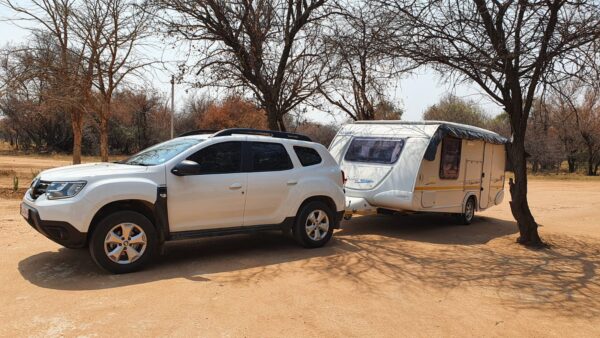
Quick Checklist Before You Leave:
- Check that your license code is EB (or EC/EC1).
- Check that your vehicle and caravan licence discs are valid, and displayed correctly.
- Ensure your caravan’s GVM is less than your car’s Tare. (And that your caravan is packed correctly and not overloaded.)
- Verify that all lights (indicators, brake, and park) are functioning.
- Double-check that the hitch is locked and the safety chain is secure, and the handbrake is down.


